> For the complete documentation index, see [llms.txt](https://docs.nifty.ai/llms.txt). Markdown versions of documentation pages are available by appending `.md` to page URLs; this page is available as [Markdown](https://docs.nifty.ai/analytics/orders.md).
# Orders
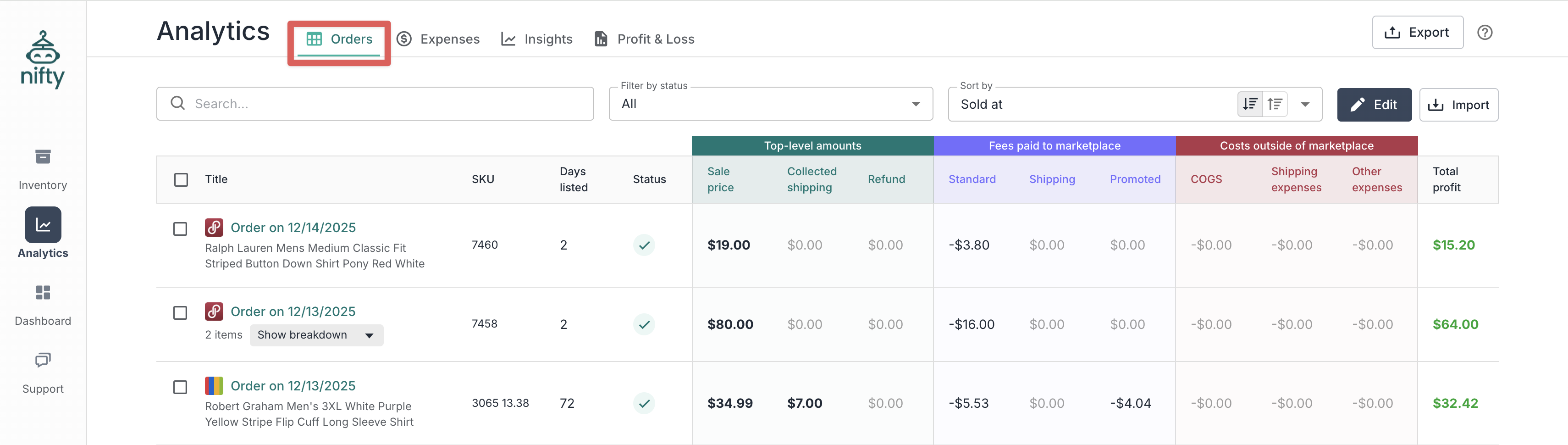
The **Orders** table gives you a complete view of your sales across all marketplaces. Nifty automatically parses receipts to extract marketplace fees, shipping fees, and promoted fees — so you can track profits without manual data entry.
### Where to find it
Go to [**Analytics**](https://app.nifty.ai/analytics) → **Orders**.
### What's imported automatically
For each sale, Nifty pulls in:
| Field | Description |
| ---------------------- | --------------------------------------------------------- |
| **Sale Price** | The amount the item sold for |
| **Collected Shipping** | Shipping fee collected from the buyer (see note below) |
| **Refund** | The amount refunded to the buyer, if any |
| **Standard Fees** | Transaction and platform fees charged by the marketplace |
| **Shipping Fees** | Cost of shipping labels purchased through the marketplace |
| **Promoted Fees** | Advertising fees for promoted listings |
#### How Collected Shipping works
This field shows shipping payments you received from buyers — but it varies by platform:
**eBay and Etsy:** The buyer pays you for shipping, then you purchase a label. Both amounts appear in your analytics (**Collected Shipping** and **Shipping Fees**).
**Poshmark, Mercari, Depop, and Whatnot:** The marketplace collects shipping directly from the buyer and provides you a label. Since you're not involved in the transaction, **Collected Shipping** is $0 for these platforms. However, Poshmark allows you to offer a shipping discount, which will show up as **Shipping Fees**.
{% hint style="info" %}
**Note:** If you ship on your own (not using the platform's labels), we can't capture that shipping data.
{% endhint %}
### What you can edit
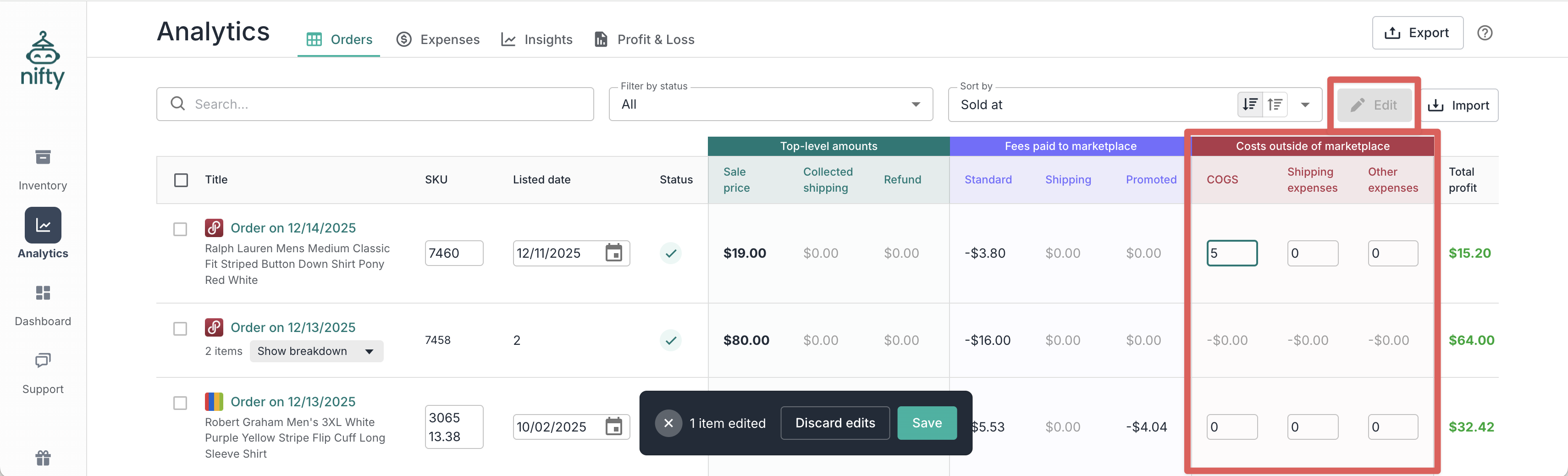
When a sale is linked to an item in your **Inventory Manager**, we automatically pull through the SKU, listed date, and **Cost of goods**. All of these remain editable.
Click **Edit** on any sale to add:
* **Shipping Costs** — Shipping costs outside the marketplace (third-party tools, etc.)
* **Other Costs** — Any per-sale costs you want to track
For bulk expenses not tied to specific sales, use the **Expenses** tab instead.
### Sale statuses
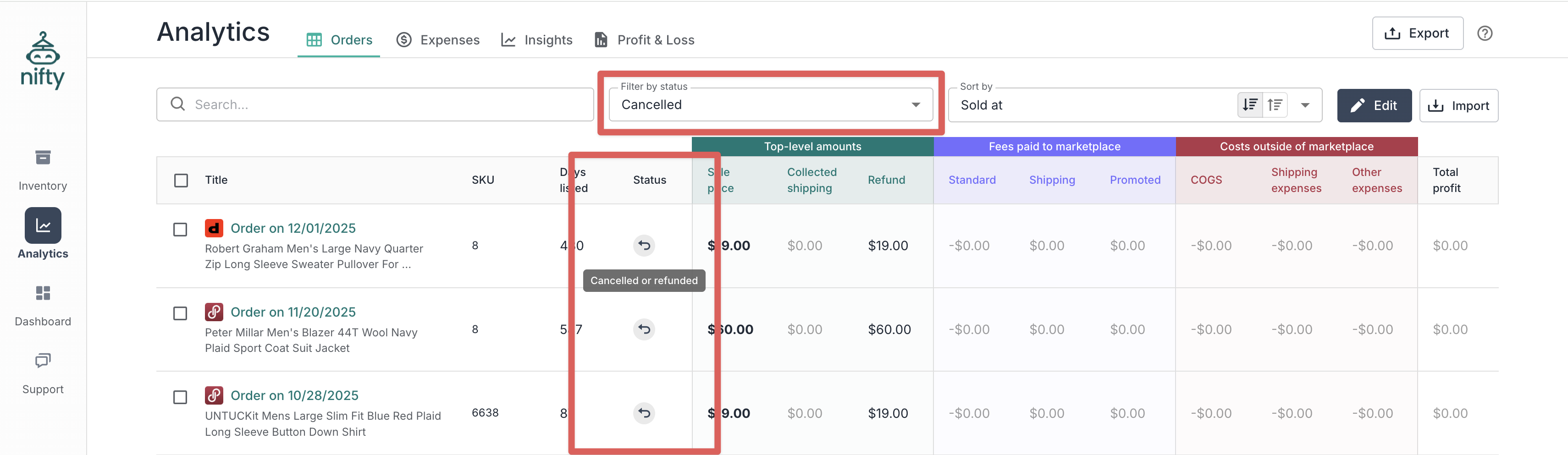
Use the status filter to find specific types of sales:
| Status | Meaning |
| ---------------------- | ---------------------------------------------------- |
| **Pending Data** | Sale detected, but full details aren't available yet |
| **Completed** | All data imported successfully |
| **Partially Refunded** | Buyer received a partial refund |
| **Cancelled** | Sale was cancelled or fully refunded |
| | |
{% hint style="warning" %}
**Important:** **Pending Data** sales are excluded from Insights. **Refresh** them to include in your reports.
{% endhint %}
### Refreshing and importing data
When Nifty detects a sale, some details may not be immediately available. Shipping labels are generated after checkout, and refunds happen later.
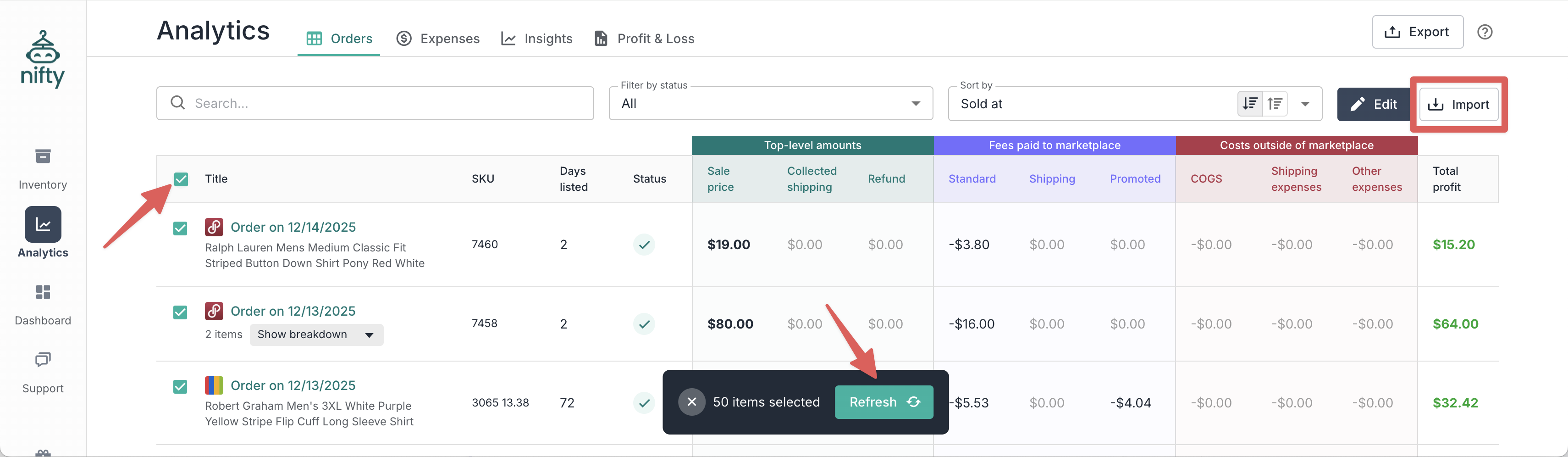
**Refresh** — Select specific rows and click **Refresh** at the bottom to pull the latest data.
**Import** — Click **Import** in the top-right to bulk-refresh an entire time period, or to pull in sales that happened before you added items to Nifty.
### Historical orders
Nifty can import up to one year of sales history, calculated from today's date. When you first sign up, we recommend clicking **Import** in the top-right, selecting your date range, and pulling this data in. This will allow you to easily compare this year's performance to last year's.
### When sales don't appear
**eBay:** Sometimes orders need to be marked as shipped before they can be imported. If you don't see a sale, ship the order and try again.
**Mercari:** Orders always need to be shipped before import. You can verify this yourself — if you check [Mercari's Sales Reports](https://www.mercari.com/us/selling/reports/), the sale won't appear there either until it's shipped.
{% hint style="info" %}
**Note:** After a sale is detected, Nifty will automatically try to bring it into your **Analytics** for 72 hours. That window starts when the sale is detected, not when you ship it — if the order isn't shipped within those 72 hours, you'll need to **Import** it manually once it is.
{% endhint %}
### Offline sales
Nifty doesn't support manual sale entry yet — we're focused on expanding marketplace integrations and don't want to create conflicts with auto-detected sales.
If you sell in person, at markets, or on unsupported platforms (for example, Facebook Marketplace), we recommend tracking those sales in a separate spreadsheet for now.
### eBay auctions
Although auction-style listings can't be brought into the **Inventory Manager**, their sales data can be brought into **Analytics** by clicking **Import** in the top-right.
### Limitations
There are a few cases where we can't extract complete data:
On **eBay**, we can't extract **Shipping Fees** for international orders. We also can't get **Shipping Fees** for labels purchased through PayPal or the Bulk Shipping Tool — these are API limitations on eBay's side.
On **Etsy**, we can't extract **Shipping Fees** or **Promoted Fees** (offsite advertising fees) due to API limitations.
For such sales, we recommend either:
* Clicking [**Edit**](#what-you-can-edit) at the top right, and entering the correct fees in **Shipping Costs** and **Other Costs**.
* Adding an [**Expense**](/analytics/expenses.md) that represents your fees for the week, month, etc. depending on your bookkeeping preferences.
---
# Agent Instructions
This documentation is published with GitBook. GitBook is the documentation platform designed so that both humans and AI agents can read, navigate, and reason over technical content effectively. Learn more at gitbook.com.
## Querying This Documentation
If you need additional information that is not directly available in this page, you can query the documentation dynamically by asking a question.
Perform an HTTP GET request on the current page URL with the `ask` query parameter, and the optional `goal` query parameter:
```
GET https://docs.nifty.ai/analytics/orders.md?ask=&goal=
```
`ask` is the immediate question: it should be specific, self-contained, and written in natural language.
`goal` is optional and describes the broader end goal you are ultimately trying to accomplish on behalf of the user. GitBook uses it to tailor the answer towards what is most useful for that goal.
The response will contain a direct answer to the question and relevant excerpts and sources from the documentation.
Use this mechanism when the answer is not explicitly present in the current page, you need clarification or additional context, or you want to retrieve related documentation sections.